

Everyday carry gets talked about as a single category, but not everything we carry serves the same purpose.
Some items are always present, while others earn their place by solving real problems.
Understanding what actually qualifies as a tool helps clarify your carry, reduce redundancy, and build a setup that’s intentional instead of cluttered.
Tools vs. Gear: The Line Most People Blur
In everyday carry, the word “tool” gets used loosely.
Knives, flashlights, pens, and wallets are often grouped together, but not everything you carry actually functions as a tool.
At MetalDetected, the distinction is simple: tools are items designed to apply force, perform work, or solve a mechanical problem.
That definition helps keep your carry intentional — and your setup lighter.
What Makes Something a Tool
A true EDC tool usually checks at least one of these boxes:
- applies leverage or torque
- manipulates or alters another object
- solves a physical problem
- replaces a larger tool in a compact form
If it’s designed primarily for action rather than presence, it belongs in the tools category.
Common Examples of EDC Tools
Tools don’t need to be large or complex.
Some of the most useful ones are small and unassuming:
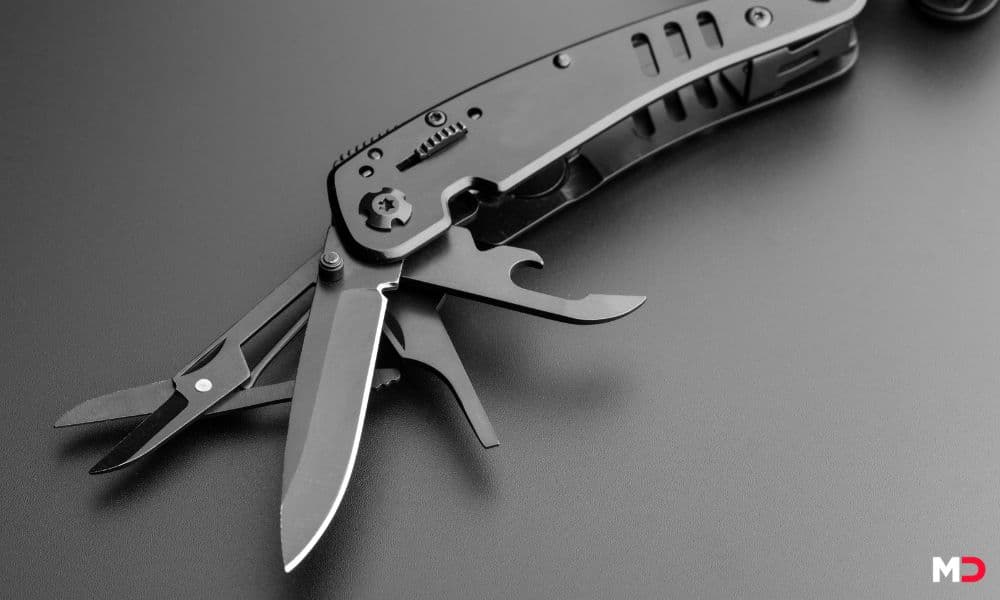
- multitools
- pry bars
- compact drivers
- bit holders
- micro scissors
- tweezers
- cutters and nippers
These items earn their place by doing something specific and doing it well.
Why Knives and Flashlights Aren’t Tools Here
While knives and flashlights can be used as tools, they function differently.
A knife is a cutting instrument you carry daily, and a flashlight is a visibility aid.
They’re always with you, even when you don’t plan to use them.
Tools, on the other hand, are problem-solvers.
You carry them because you expect they’ll be needed — not just because they’re part of your everyday baseline.
That’s why MD treats knives and flashlights as gear, and things like prybars and multitools as tools.
The Role of Tools in a Minimal Carry
Good EDC tools reduce friction.
They prevent small problems from becoming big ones — a loose screw, a stubborn lid, a snagged staple, a bent clip.
The goal isn’t to carry everything.
It’s to carry the right thing.
A single well-chosen tool often replaces three poorly chosen ones.
Final Take
Everyday carry tools aren’t about preparedness fantasies or oversized kits.
They’re about quiet capability.
If an item helps you fix, adjust, pry, cut, or manipulate something in the real world, it deserves to be called a tool.
And if it doesn’t?
It probably belongs somewhere else in your carry.